
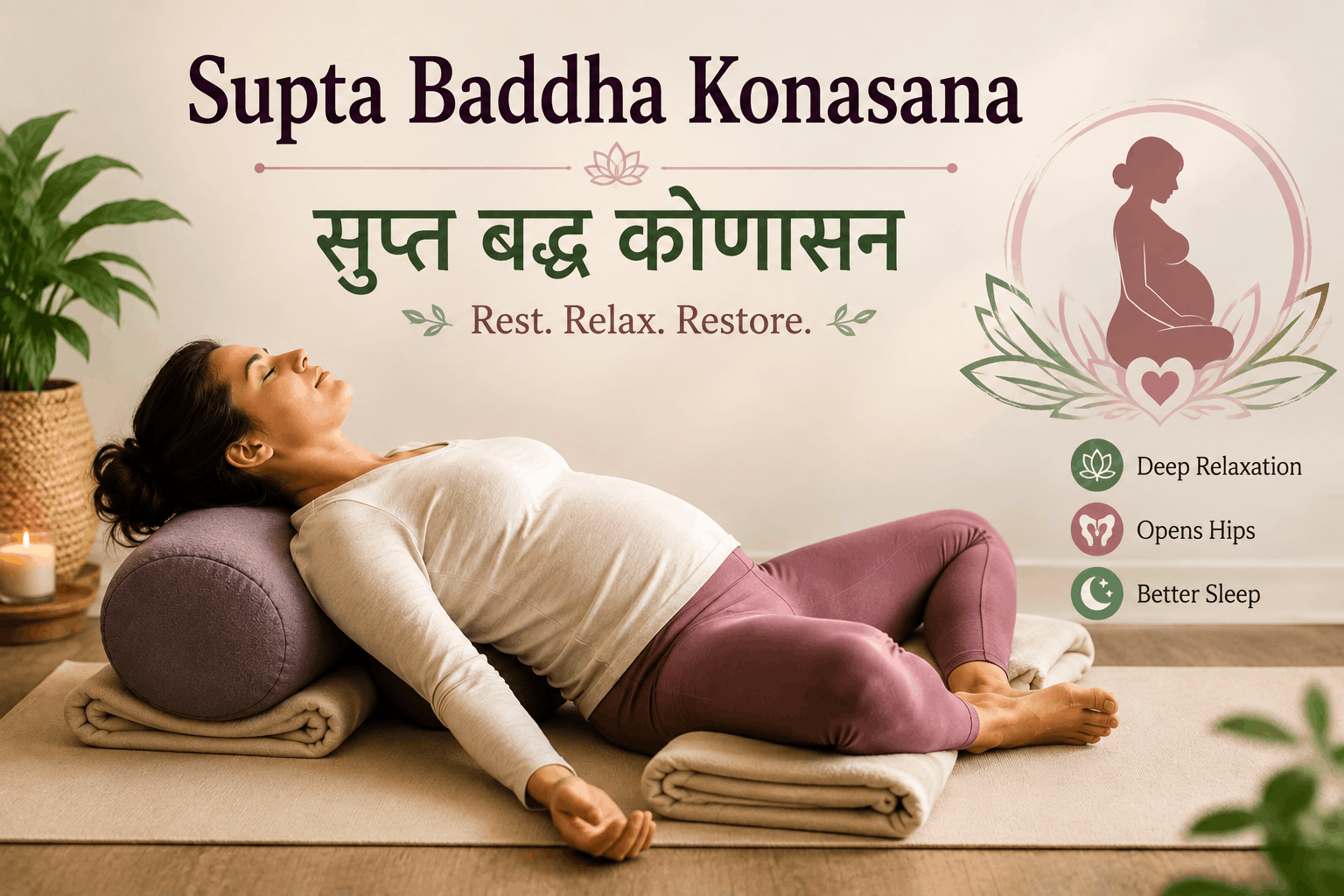

Looking for a deeply restful yoga pose to add to your fertility routine? Supta Baddha Konasana (Reclining Bound Angle Pose) is a supported, beginner-friendly restorative pose that gently opens the hips, softens the lower belly, and encourages slow, mindful breathing. Many women include it in their evening wind-down because it helps the body shift out of “busy mode” and into rest. While Supta Baddha Konasana cannot treat infertility or guarantee pregnancy, practising it regularly as part of a healthy lifestyle may support your overall health and reproductive wellness.
According to yoga experts, it is one of the most calming poses in restorative practice because the body is fully supported and no muscular effort is required.
Supta Baddha Konasana for Fertility at a Glance
- Also Known As: Reclining Bound Angle Pose, Reclining Butterfly Pose
- Difficulty: Beginner
- Best Time: Evening or before bedtime, on an empty stomach
- Hold Time: 5–15 minutes
- Props Needed: Bolster or firm pillow, 2 folded blankets
- Main Benefits: Deep relaxation, hip opening, gentle abdominal release, better sleep
- Good For: Stress relief, menstrual discomfort, tight hips, evening recovery
- Avoid If: You have a recent hip, knee or groin injury, sacroiliac (SI) joint pain, severe lower back problems, or your healthcare provider has advised against reclining poses.
Discover another beginner-friendly relaxing pose in Legs-Up-the-Wall Pose for Fertility.
What Is Supta Baddha Konasana (Reclining Bound Angle Pose)?
Supta Baddha Konasana is a reclining yoga pose in which you lie on your back, bring the soles of your feet together, and let your knees drop out to the sides so your legs form a diamond shape. The spine is supported on a bolster or folded blanket, and each thigh rests on a cushion so the hips can release without strain.
Think of it as the resting version of the seated Butterfly Pose (Baddha Konasana). Because gravity does the work while you lie back, the pose becomes restorative rather than active — it asks almost nothing of you physically, yet creates space in the hips and calm in the nervous system.
Want the active, seated version? Read our guide to Butterfly Pose Benefits.
Can Supta Baddha Konasana Support Fertility?
There is no strong scientific evidence that this pose directly improves fertility, increases ovulation, or raises the chance of pregnancy. What research on yoga does suggest is that regular practice may help reduce stress, anxiety and low mood in women trying to conceive or going through fertility treatment.
That matters, because stress often quietly disrupts the very habits that support reproductive health: sleep, appetite, exercise, and connection with your partner. A pose that helps you feel calmer isn’t a fertility treatment, but it can make it easier to keep those habits going.
Benefits of Supta Baddha Konasana for Fertility
1. Helps Calm the Nervous System
When you lie back fully supported and breathe slowly, the body naturally shifts towards its “rest and digest” state. According to yoga experts, this is where restorative poses do their real work — not in stretching harder, but in letting the body stop bracing.
2. Gently Opens the Hips and Inner Thighs
Most of us sit for hours a day, and the hips quietly tighten as a result. This pose lets the inner thighs release slowly under their own weight. According to yoga experts, always support each thigh with a folded blanket so the stretch stays passive — you should feel opening, never pulling.
3. Softens the Lower Belly and Pelvic Floor
Stress tends to show up as clenching: jaw, shoulders, and often the pelvic floor. This pose creates the conditions for those muscles to let go. A relaxed pelvic floor is simply healthier and more comfortable, whether or not you are trying to conceive.
Learn more in our guide to Malasana Pose Benefits.
4. May Ease Menstrual Discomfort
Reclining Bound Angle Pose is one of the poses most commonly recommended during a period, because it eases pressure across the lower abdomen without twisting or compression. According to yoga experts, adding a light blanket over the belly can feel especially comforting on heavy days.
5. Encourages Slow, Deep Breathing
With the chest slightly lifted over a bolster, the front of the ribs opens and the breath deepens on its own. Try a 4-second inhale and a 6-second exhale. According to yoga experts, lengthening the exhale is one of the simplest ways to signal safety to the nervous system.
Strengthen your practice with our 9 Benefits of Yoga That Are Supported by Science guide.
6. May Improve Sleep Quality
Practised 20–30 minutes before bed, this pose helps unwind the day. Better sleep supports hormone regulation, mood and energy — all of which matter for overall reproductive health.
7. Supports Overall Reproductive Wellness
Fertility depends on many factors — nutrition, sleep, body weight, medical history, age, and stress management. This pose is not a treatment for any of these, but it is a gentle, low-risk habit that supports the lifestyle side of the picture. According to yoga experts, consistency matters far more than intensity.
How to Do Supta Baddha Konasana (Reclining Bound Angle Pose)
- Place a bolster or firm pillow lengthways on your mat, and sit just in front of its short end so it will run along your spine.
- Bend your knees, bring the soles of your feet together, and draw them a comfortable distance from your body — further away is gentler.
- Slide a folded blanket or cushion under each outer thigh so your legs are fully supported.
- Using your hands for support, lower yourself slowly back onto the bolster so your spine and head are resting on it.
- Let your arms rest by your sides, palms facing up, shoulders relaxed away from your ears.
- Close your eyes. Breathe slowly through the nose, letting the exhale be longer than the inhale.
- Stay for 5–15 minutes, doing nothing at all.
- To come out, press your knees together with your hands, roll gently onto your right side, rest, then press up to sitting.
Beginner tip: No bolster? Stack two firm pillows or roll a thick blanket lengthways. The pose works just as well with household props.
Discover another gentle stretch in Paschimottanasana for Fertility.
Tips to Get the Most Benefits
- Practise on an empty stomach, or at least 2 hours after a meal.
- Always support the outer thighs — never let the knees hang unsupported.
- Move the feet further from the pelvis if you feel any groin strain.
- Keep the throat and jaw soft.
- Use an eye pillow or light cloth over the eyes to deepen the relaxation.
- Stay warm — the body cools during rest.
- Come out slowly; never sit up straight from the reclined position.
- Consult your doctor if you have fertility concerns or an existing condition.
Best Time to Practise Supta Baddha Konasana
Evening or before bedtime is ideal, as the pose is calming rather than energising. It also works well as the final pose of any yoga session, in place of Savasana. Wear loose clothing, use a mat on a flat, quiet surface away from screens, and focus on slow breathing for the whole hold.
Who Should Avoid Supta Baddha Konasana?
Avoid or modify this pose if you have:
- A recent hip, knee, or groin injury or surgery.
- Sacroiliac (SI) joint pain or instability.
- Severe lower back problems that worsen when lying flat.
- Recent abdominal surgery.
During pregnancy: From the second trimester onwards, lying flat on the back for long periods is generally discouraged. The pose can usually be adapted by raising the bolster to a steep incline so the chest sits well above the hips — but always check with your healthcare provider or a qualified prenatal yoga instructor first.
What Does Research Say?
Reviews of yoga in women undergoing fertility treatment consistently report reductions in stress, anxiety and depression scores, and researchers generally describe yoga as a safe, low-cost complementary practice. However, the evidence base is small, study designs vary widely, and researchers themselves call for larger randomised controlled trials. No study has shown that any single pose — including Supta Baddha Konasana — improves conception rates on its own. Treat it as supportive self-care, not as treatment.
A Simple 15-Minute Evening Wind-Down
- Cat-Cow Pose — 2 minutes of gentle spinal movement.
- Child’s Pose — 2 minutes of forward folding and slow breath.
- Butterfly Pose (seated) — 2 minutes to warm the hips.
- Supta Baddha Konasana — 6 minutes fully supported.
- Legs-Up-the-Wall Pose — 3 minutes to finish.
Build a complete routine with our 8 Best Yoga Poses for Fertility guide.
FAQs
Can Supta Baddha Konasana help me get pregnant?
No. It cannot guarantee pregnancy or treat infertility. It may help reduce stress and support relaxation and overall well-being, which matter for general reproductive health.
How long should I hold Reclining Bound Angle Pose?
Most beginners are comfortable between 5 and 15 minutes. Start with 5 and build up as your hips relax.
Can I practise it every day?
Yes. For most healthy adults this is a gentle, low-risk pose that can be practised daily, provided you use props and feel no pain.
Is it safe during my period?
Yes — it is one of the poses most often recommended during menstruation because it involves no compression of the abdomen.
What is the difference between Baddha Konasana and Supta Baddha Konasana?
Baddha Konasana (Butterfly Pose) is done sitting upright and is more active. Supta Baddha Konasana is the reclining, supported version — the hips open passively while you rest.
What if my knees are far off the floor?
That’s completely normal. The knees do not need to touch the ground. Raise the support under each thigh until the legs feel held, and let the hips open over time.
Learn how to practise a gentle backbend safely in Bridge Pose for Fertility.
Conclusion
Supta Baddha Konasana for Fertility is a supported, beginner-friendly restorative pose that helps release the hips, quiet the mind, and encourage slow, deep breathing. It cannot treat infertility or guarantee pregnancy — no single pose can. But as a daily habit alongside a balanced diet, quality sleep, regular movement, and guidance from your healthcare provider, it can become one of the calmest few minutes of your day.
On a journey that often asks for so much effort and patience, this is a pose that asks for nothing at all. Set up your props, lie back, and let your body rest.
Disclaimer: This article is for informational purposes only and is not intended as medical advice. Consult a healthcare professional for personalized guidance.